Skip navigation menu
Updated October 14, 2026
Issue 7A is the Front Range Passenger Rail District’s Colorado Connector measure on the November 3, 2026 ballot.
What is the Colorado Connector?
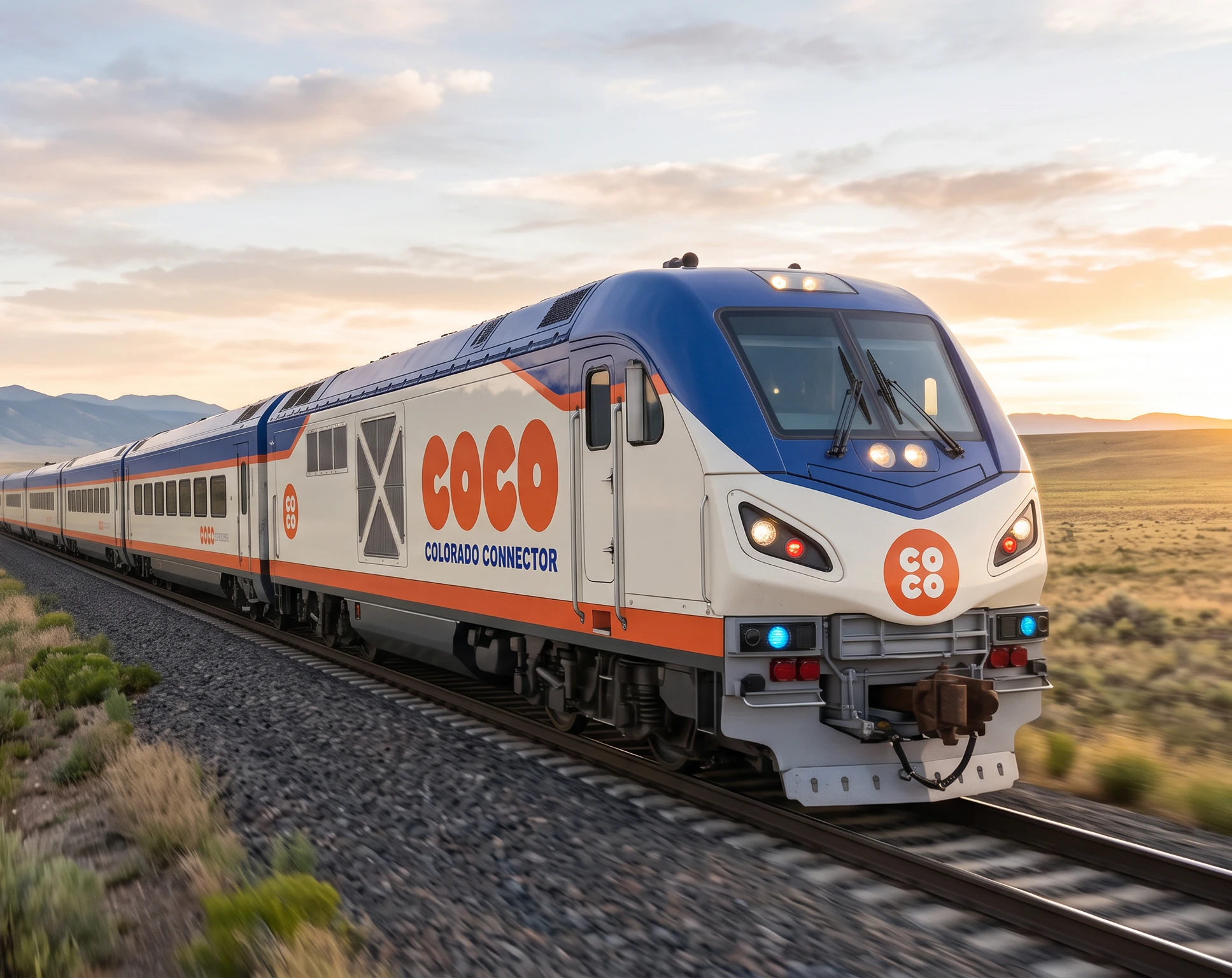
The Colorado Connector, or CoCo, is daily passenger rail service connecting 12 Front Range communities from Fort Collins to Pueblo, with up to 10 round trips a day. It runs on track that already exists, in partnership with Amtrak and the host railroads, which reduces costs and speeds deployment, with the first trains rolling as soon as 2029. From Denver Union Station, riders connect to the A Line to Denver International Airport, making airport access easier from across the Front Range.
What does Issue 7A do?
Issue 7A funds the Colorado Connector with a sales tax of a third of a penny per dollar across the Front Range Passenger Rail District. Groceries, gas, home utilities, prescriptions, and medical supplies are exempt. The tax is expected to raise about $295 million a year, which covers build out and operations. Starter service between Fort Collins and Denver is already funded, with 7A extending trains south to Colorado Springs and Pueblo and growing frequency across the whole corridor.
Why does Colorado need the Colorado Connector?
The Colorado Connector gives the Front Range an alternative to I-25, which is more congested than it was even a few years ago and getting worse. The Denver Regional Council of Governments (DRCOG) projects that by 2050, 2 PM traffic in the Denver area will be as heavy as 5 PM traffic is today. Over that same stretch, DRCOG expects driving on the region’s freeways and major roads to grow 43% and the hours we spend stuck in traffic to grow 60%. At the same time, the cost of owning and driving a car has hit record highs. Transportation is now the second-largest expense for Colorado households, running more than $15,000 a year per family. Gas is only part of it: insurance, maintenance, and depreciation alone cost about $12,900 per car per year.
Current policies aren’t enough to deal with the gridlock we already face, let alone the increased congestion as Colorado continues to grow. The Colorado Connector (CoCo) gives people a real alternative to driving, and every rider who takes the train is one less car in front of everyone else. Issue 7A puts new transportation options within reach for commuters and families up and down the Front Range.
What are the key benefits of passing Issue 7A?
Gets cars off the road. The Colorado Connector gives drivers a practical alternative, taking an estimated 29,000 cars off the road and delivering 1.27 million trips a year.
Uses the tracks we already have. Building on existing rail is the responsible way to control costs and expand step by step over time.
More homes, cleaner air. An estimated 24,000 new walkable homes will be built near CoCo stations and the train service will cut greenhouse gas (GHG) emissions by roughly 124,500 tons per year.
Connects the Front Range. Jobs, games, campuses, downtowns, and the airport, from Fort Collins to Pueblo.
Grows Colorado’s economy. Rail is a proven economic multiplier: every $1 invested generates $5 in economic activity, including $3 in local sales.
How will the Colorado Connector benefit the environment?
Transportation is the largest source of greenhouse gas pollution in Colorado, and most of us have no alternative to driving for longer trips along the Front Range. CoCo changes that. An independent analysis by the Southwest Energy Efficiency Project (SWEEP) found that at full buildout, the Colorado Connector could cut greenhouse gas emissions by roughly 124,500 metric tons a year and eliminate nearly 233 million vehicle miles of driving annually by 2045.
Those benefits come from two places. The first is the obvious one: replacing car trips with train trips. CoCo’s projected 1.27 million annual passenger trips would eliminate about 30.7 million vehicle miles of driving each year, and the hybrid Tier 4 trains CoCo plans to run are about 83% cleaner than comparable car travel.
The second is bigger. Stations anchor walkable neighborhoods, and people who live in them drive about 30% fewer miles than their neighbors. SWEEP projects more than 24,000 new homes within a half mile of CoCo stations by 2045. Those homes also use about 70% less energy than detached houses and far less water, saving an estimated 781 million gallons a year.
How will the Colorado Connector improve air quality and gas consumption?
The Colorado Connector cuts fuel use by taking trips off I-25. Sitting in traffic burns fuel that gets nobody anywhere. According to the Urban Mobility Report, the average Denver metro commuter burned an extra 20 gallons of gas in 2024 because of traffic delays alone, up from the year before. Every trip that moves to the train is fuel not burned and exhaust not added to the air we all breathe. Cleaner air is a benefit for the people who never ride.
How does the Colorado Connector help with housing and cost of living?
Walkable neighborhoods around Colorado Connector stations are where the Front Range can put some of the 1.3 million new residents expected by 2050 without creating more sprawl. Colorado households in transit-connected urban neighborhoods spend about half as much on transportation as other households, close to $9,000 a year in savings. Issue 7A also includes a Local Return program, roughly $1.5 billion over the life of the project, that flows back to station communities for sidewalks, bike and pedestrian connections, local transit, affordable housing, and other station-area improvements.
How much will Issue 7A cost me?
Issue 7A is a sales tax of a third of a penny on the dollar, or 33 cents on a $100 purchase. Groceries, gas, home utilities, prescriptions, and medical supplies are exempt, so taxes won’t rise on everyday essentials.
Who votes on Issue 7A?
The communities nearest the planned Colorado Connector stations will vote on Issue 7A and are part of the Front Range Passenger Rail District. This includes communities along the planned route: parts of Fort Collins, Loveland, Longmont, Boulder, Louisville, Broomfield, Westminster, Denver, Littleton, Sterling Ranch, Colorado Springs, and Pueblo. If voters approve it, the sales tax applies within that same district.
Why did some voters outside the District receive ballots with Issue 7A?
Issue 7A will be decided by voters in the Front Range Passenger Rail District, a special district the state legislature created to plan and operate the Colorado Connector.
In 2021, while the train service was still being planned, the legislature set the District’s original boundaries using county lines, metropolitan planning organization boundaries, and certain areas near I-25. Once the final route was determined, in 2026 the legislature narrowed the District boundaries to the municipalities and communities closest to the planned stations. However, the county clerks who administer local elections did not receive updated maps reflecting the new boundaries. As a result, clerks in four of the District’s 13 counties (Adams, Arapahoe, Douglas, and Weld) mailed ballots with Issue 7A to voters who live in their county but outside the District.
Working with the Secretary of State, the county clerks have a process in place to ensure every eligible vote is counted. They recommend that residents vote their full ballot and cast it as they normally would. Clerks will sort ballots by District boundary so that only votes from eligible voters count toward Issue 7A. Every other vote on every ballot will be counted as usual.
Which municipalities are in the Front Range Passenger Rail District?
If you live in one of these municipalities or unincorporated communities, you are in the Front Range Passenger Rail District and will have your vote on Issue 7A counted.
Arvada
Boulder
Bow Mar
Broomfield
Centennial
Cherry Hills Village
Colorado Springs
Columbine Valley
Denver
Edgewater
Englewood
Federal Heights
Fort Collins
Glendale
Greenwood Village
Lafayette
Lakeside
Lakewood
Littleton
Longmont
Louisville
Loveland
Manitou Springs
Mountain View
Pueblo
Sheridan
Starkville
Sterling Ranch
Superior
Trinidad
Westminster
Wheat Ridge
How much will the Colorado Connector cost to build and operate?
Annual operating costs for the Colorado Connector are projected between $85 million and $116 million at full service, substantially lower than some opponents have claimed. By comparison, Colorado spends about $3.1 billion a year on roads alone, and California’s high-speed rail project is estimated to cost $126 billion for its first phase. By building on tracks we already have, the Colorado Connector shortens construction time and cuts costs, getting trains running for a fraction of what it costs elsewhere.
How fast will the Colorado Connector go? Why not high-speed rail?
Top speed on the Colorado Connector will be 79 mph, and end to end the train will be time-competitive with daytime driving. High-speed rail requires entirely new track, costly right-of-way acquisition, and major bridges and tunnels, which push costs up by orders of magnitude. California’s first phase alone is estimated at $126 billion. Using existing track is a much faster and far more affordable way to get reliable train service people can use as soon as 2029.
What is the difference between Phase 1 and the phases Issue 7A funds?
Phase 1, the starter service, covers Fort Collins to Denver and is funded separately from Issue 7A: $156 million from RTD’s FasTracks savings account plus new state revenue the legislature created in 2024 from rental car and oil and gas fees. That covers the $332 million capital cost, with operating costs shared by the state and RTD. While the Colorado Connector is independent of and not operated by RTD, it will help break the 22-year logjam on RTD’s Northwest Rail promise and gets 3 round trips a day running. Issue 7A funds Phases 2 and beyond, allowing for the southern extension and the frequency increases across the whole corridor.
Is the Colorado Connector run by RTD?
No. Issue 7A is the Front Range Passenger Rail District’s Colorado Connector measure on the November 3, 2026 ballot. It is a different measure from RTD’s 2024 Ballot Issue 7A. The Colorado Connector is overseen by the Front Range Passenger Rail District, a special transportation district created by the state legislature to implement passenger rail service up and down the Front Range. While RTD contributes some funding to the project, the Colorado Connector is an independent entity. Starter service for Phase 1 of the Colorado Connector will be run by Amtrak, with future operators determined when the system is built out.
How do existing FasTracks dollars fit into the Colorado Connector?
Taxes already collected for FasTracks are helping pay for the Colorado Connector starter service. When voters approved FasTracks in 2004, it funded light rail, bus, transit hubs, and park-and-rides across the Denver metro counties. Issue 7A delivers that transit connection while expanding rail service to Colorado Springs and Pueblo and increasing the frequency of trains across the entire system.
How many riders will the Colorado Connector carry?
The Colorado Connector is expected to pass 1 million annual passenger trips in its middle phases and up to 2 million annual trips over time, consistent with comparable services. Demand for intercity transit in Colorado is already outrunning projections: CDOT’s Bustang ridership has grown fivefold since 2021, demonstrating strong demand for service like the Colorado Connector.
How does the Issue 7A Local Return program work?
A share of revenue from Issue 7A flows back to station communities for station-area improvements, sidewalks, bike and pedestrian access, parking, local transit, and first- and last-mile connections. Local Return money comes from sales tax revenue from Issue 7A, not ticket sales. Every station city has signed a letter of cooperation with the District. If Issue 7A passes, formal intergovernmental agreements are expected to be finalized in 2027, and communities will keep control over their own station-area priorities.
What happens first if Issue 7A passes?
If Issue 7A passes, the Front Range Passenger Rail District shifts from a planning organization to a program delivery organization. Starter service is already underway, so it won’t start from scratch; it will stand up and operate the northern service while the southern phases are planned and built. Staffing will be phased to match delivery, and the District will coordinate with state, regional, and local partners rather than duplicate what already exists.